Sympatex — Sample-to-bulk handoffs
A specification review moves a dated reference, a written difference, and an approval note together. It does not invent a mill identity or a delivery date.
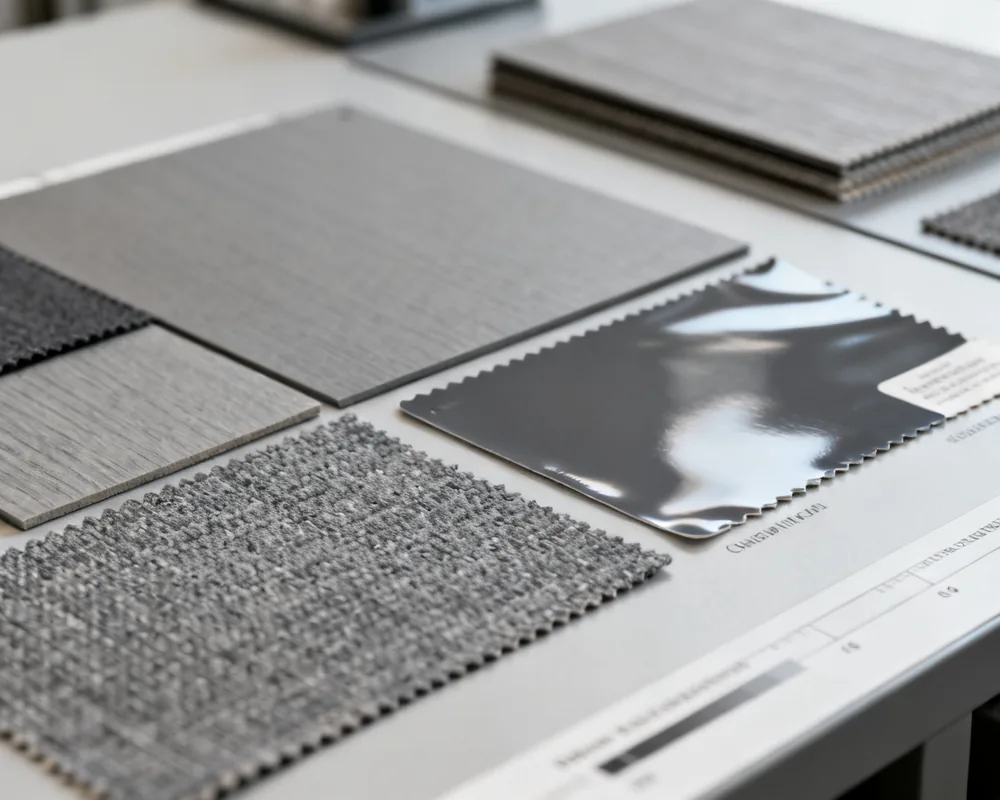
- Brief
- Sample
- Approval
- Order context
A specification review moves a dated reference, a written difference, and an approval note together. It does not invent a mill identity or a delivery date.
Write the outdoor use in one sentence, then split the construction. Name the face fabric, the membrane layer you believe is present, and the backing if the cutting in front of you actually has one. Add GSM, in g/m², as a target for a named layer, not as a slogan for the whole shell. Record usable width in centimetres separately from the full cloth width. Note fiber composition, weave construction, warp and weft when the face is woven, and yarn count when a linear density is in play: denier is grams per 9,000 metres and dtex is grams per 10,000 metres. Say whether a face finish is a coating add-on or part of a lamination. If the sympatex fabric reference is a trade phrase, keep that phrase as a locator and still describe the physical piece. Open items belong in the brief as questions: unknown bond line, unknown seam tape, unknown wash state. This step does not state that a sample is in stock.
Lay the submitted cutting next to the brief and mark what matches. Hand, shade, and face texture can be judged by eye and touch under a stated light. Liquid resistance and vapor movement cannot be judged by eye. If a report arrives with the cutting, copy the method title onto the same page as the number and note whether the coupon was the membrane alone, the laminate, or a seamed panel. When the sheet cites the standard textile atmosphere, check 20 °C and 65 % relative humidity and the printed tolerances of ± 2 °C and ± 4 % RH. Hydrostatic head, water vapor transmission, air permeability, tear strength, and tensile strength do not share one cell. A review that mixes membrane, laminate, and seam specimens will look precise and still be unusable. Differences you want explored — softer face, lighter mass, different backing — should be written as requested changes, not as properties already measured. A lab dip is not a shade band and not a colorfastness result.
An approval note should say which decision it covers. Approving hand does not approve a hydrostatic head. Approving a shade under daylight does not approve colorfastness after washing, and it does not approve pilling or abrasion resistance. Keep the physical standard, the date, and the construction description in one packet so a later roll inspection can point back to the same object. Dimensional stability and stretch recovery need their own notes if the shell will be washed or flexed. If the face finish, the membrane, or the bond was altered after the note, the note no longer describes the piece in the room. Say that plainly and open a new comparison instead of stretching the old sentence across a changed build. Seam slippage at a taped join is outside a panel approval.
Order context is quantity, supply format, identification, and destination. Those fields frame a commercial conversation. They do not prove that a sample is available, that a roll length is fixed, or that a certificate covers the goods. Ask which packing format applies to this material — roll, cut length, or another unit — and leave timing blank until a specific reply exists. If documentation is part of the purchase discussion, ask for the holder, the product scope, the date, and the version rather than a logo on a slide.
A service conversation stays usable when the material question, the sample question and the order question are written on separate lines. Composition, construction, GSM, usable width and finish describe the textile. Quantity, destination and requested timing describe the commercial request. A target requirement is not a reported result, and a page statement is not a batch approval.
| Request | Include | Keep separate |
|---|---|---|
| Sample discussion | Reference, colour direction and intended use | A screen image is not the approval standard |
| Specification question | Composition, construction, GSM, usable width and finish | An unknown value stays blank |
| Availability question | Material reference and the quantity under discussion | A catalogue page is not a delivery promise |
| Order context | Destination and the decision that still needs an answer | Do not merge it into the sample record |
Share the sample reference and the order fields you already know. Leave unknown test values blank.